You’re loading the car for a weekend trip and you crouch down to check the tires out of habit, the way you always do before a longer drive. One of them looks a touch softer than the others. Not flat, nothing alarming, just noticeably less firm than it was a month ago. Tire pressure does this quietly as the seasons change. As a general rule of thumb, pressure can shift by roughly 1 PSI for every 10°F change in temperature, though this varies somewhat by tire and isn’t an exact measurement. Most drivers only notice the drop when a dashboard warning light finally catches up to what the tire already knew.
This is the everyday case for owning a portable tire inflator, and it has almost nothing to do with roadside emergencies. A portable tire inflator lets you correct pressure in your own driveway, on your own schedule, instead of waiting for a problem to force a stop at a gas station with an air pump that may or may not be working. Used this way, a car tire inflator becomes part of routine car tire maintenance rather than a piece of emergency gear that sits untouched in the trunk for years.
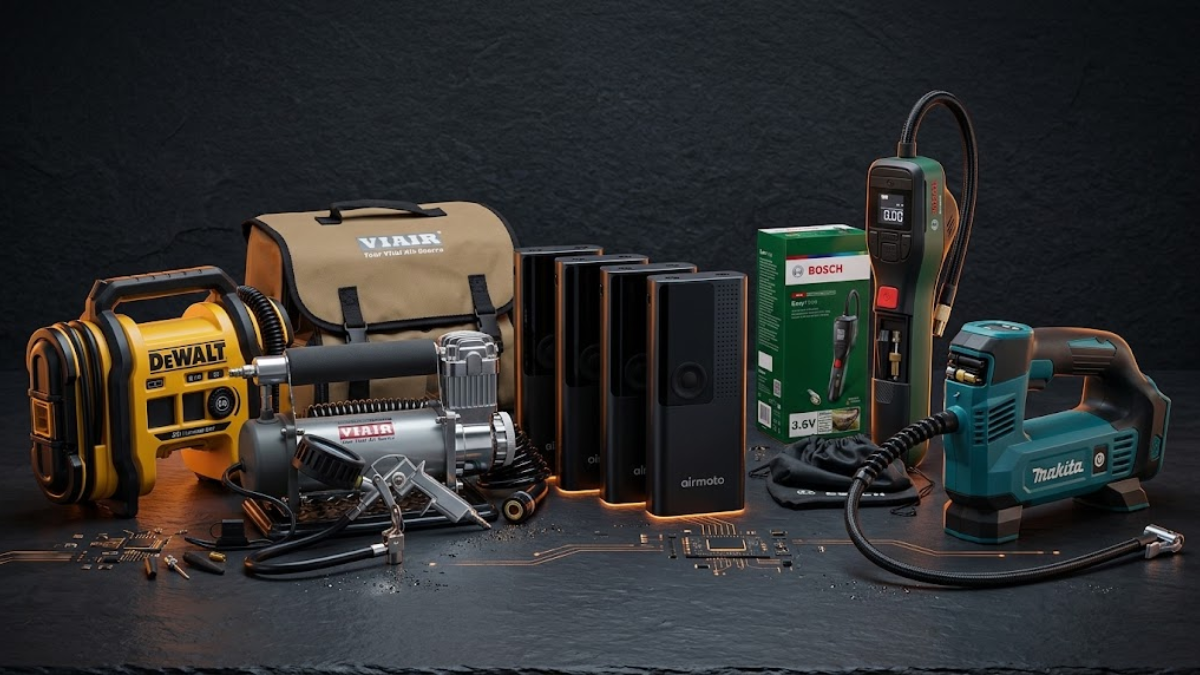
The category itself is broader than it looks at first glance. Some inflators plug into a vehicle’s electrical system and are built for serious, repeated use. Others run on cordless power tool batteries from brands like Makita and DEWALT, useful mainly if you already own that battery platform. And some are small enough to live in a glovebox and get forgotten about until the exact moment you need them. This guide covers five specific portable air compressors for car tires, what each one is actually suited for, and how to think through the decision based on your own vehicle and habits.
Quick Comparison
| Product | Power Source | Maximum Pressure | Best Suited For | Portability |
|---|---|---|---|---|
| Makita DMP180ZX | Makita 18V LXT battery (sold separately) | 120 PSI | Drivers already invested in the Makita 18V tool system | Compact, about 2.3 pounds without battery |
| Bosch EasyPump | Built-in rechargeable battery (3.6V, 3Ah), USB charging | 150 PSI | Everyday topping off, travel, small items like bikes and balls | Very compact, about 0.43 kg |
| Airmoto Tire Inflator (4 Pack) | Not clearly specified | Not clearly specified | Households or multiple vehicles wanting several units on hand | Small per unit, but detailed specs are not clearly established |
| VIAIR 450P / 45043 | 12V, connects via heavy-duty battery clamps with inline fuse | 150 PSI max working pressure | Trucks, SUVs, Jeeps, and larger or repeated inflation jobs | Larger and heavier, about 13.05 pounds, carry bag included |
| DEWALT DCC020IB | 20V MAX battery, 12V DC, or 110V AC | 160 PSI | Drivers who want flexibility across battery, car, and wall power | Moderate size, exact weight not specified here |
Where a specification could not be confirmed from reliable product information, this article says so directly rather than filling in a number that sounds reasonable. That applies most clearly to the Airmoto listing, which has noticeably less publicly documented technical detail than the other four products.
How to Choose a Portable Tire Inflator for Your Car
Power source. This is the first real fork in the road, and it shapes almost everything else about how the tool fits into your life. A built in battery, like the one in the Bosch EasyPump, means there’s nothing extra to buy, but it also means the pump is only as reliable as your habit of charging it. A 12V compressor that draws from the vehicle, like the VIAIR, never runs out of charge on its own, but it ties the tool to your vehicle’s electrical system rather than letting it work independently. Cordless tool battery inflators split the difference: fast and portable, but only genuinely convenient if you already own compatible batteries.
Maximum pressure. Most passenger tires sit somewhere between 30 and 35 PSI, so on paper, any of these five products can handle that job without strain. The number starts to matter more once you’re dealing with larger tires, trailer tires, or all terrain tires for trucks and SUVs that have been aired down for a trail and need to come back up to street pressure afterward. Having headroom above what your tires actually need means the compressor isn’t working at its absolute limit during normal use.
Inflation speed. Small battery powered units are convenient, but they simply aren’t built to move air as fast as a stronger 12V compressor. For a tire that’s a few PSI low, this barely matters. For a tire that’s significantly deflated, the difference becomes obvious, and a more powerful unit will finish the job with less strain on itself and less waiting for you.
Portability and storage. Where the inflator actually lives day to day matters as much as what it’s capable of. Something small enough for a door pocket or glovebox gets used for quick checks before a commute. Something that has to be dug out of the trunk tends to get reserved for planned maintenance or genuine emergencies, simply because of the friction involved in reaching it.
Automatic shutoff and pressure display. An automatic shutoff that stops inflation once a target pressure is reached removes the need to stand there watching a gauge the whole time. The Makita, the DEWALT, and the Bosch EasyPump all include this. A digital or real time pressure display is worth having too, since it means you aren’t disconnecting and reconnecting a separate gauge over and over to check your progress.
Vehicle type and tire size. A sedan or small crossover rarely needs more than a compact inflator. Trucks, larger SUVs, and anyone running heavier tires are working with more air volume and often different recommended pressures, which is where a more capable 12V compressor tends to make more practical sense than a small cordless unit that will take a long time to reach target pressure.
Battery compatibility. If you already own Makita 18V LXT batteries or DEWALT 20V MAX batteries from other tools in your garage, buying the bare tool version of either inflator is a genuinely low cost way to add one to your kit. If you don’t already own that battery platform, the math changes considerably, since you’re now buying into an entire system for the sake of one tool.
Product Reviews
1. Makita DMP180ZX 18V LXT Lithium Ion Cordless Inflator

The DMP180ZX runs on Makita’s 18V LXT battery platform and is sold as a bare tool, without a battery or charger included. It reaches a maximum of 120 PSI, includes an automatic shutoff that stops once the target pressure is hit, and has a backlit pressure gauge along with a built in LED light for working in low visibility conditions. Its hose runs about 25.5 inches, giving a reasonable amount of reach without needing to reposition the tool at every tire.
The real value of this inflator depends almost entirely on whether you already own Makita 18V batteries. If you have one sitting in a drawer from a drill or an impact driver, the DMP180ZX becomes a practical addition to an existing Makita 18V LXT tool collection, since you’re only paying for the tool body. If you don’t, you’re shopping for a battery and charger on top of the inflator itself, and that changes the value proposition considerably.
At around 2.3 pounds without the battery, it’s light and compact enough to grab quickly, and the automatic shutoff means you can start it and step away rather than watching the gauge the entire time. It makes the most sense as a garage or truck bed tool for someone already committed to the Makita ecosystem, rather than a first inflator purchase on its own.
Pros:
- Automatic shutoff removes the need for constant monitoring
- Backlit gauge and built in LED work well in low light
- A practical addition for existing Makita 18V owners
- Compact and light for a cordless option
Cons:
- Battery and charger are sold separately, adding real cost for new buyers
- 120 PSI ceiling is fine for passenger tires but limits other applications
- Only worth considering if you’re already on the Makita 18V platform
2. Bosch EasyPump Mini Portable Battery Operated Compressor

The EasyPump is built around a single priority: staying small enough that carrying it is never an inconvenience. At roughly 0.43 kg, it’s noticeably smaller than every other product covered here. It runs on a built in rechargeable 3.6V, 3Ah battery, charged via USB, and reaches a maximum pressure of about 150 PSI with an airflow of roughly 10 liters per minute. It includes real time pressure measurement and an automatic shutoff once the target pressure is reached.
This is a tool built for everyday convenience rather than heavy duty output. Its size makes it realistic to keep in a door pocket or glovebox, the kind of place where a bulkier compressor simply wouldn’t fit without becoming annoying. Bosch also markets it for bikes, sports balls, and small inflatables, which lines up with its lighter duty, top off oriented design rather than positioning it as a substitute for a full sized 12V compressor.
Because its battery is built in rather than swappable, keeping it charged is entirely your responsibility. It’s not the tool you want to discover is empty during actual roadside tire emergencies, so a habit of periodic charging matters more here than it does with a plug in unit that draws power straight from the vehicle whenever it’s connected.
Pros:
- Extremely compact and light, easy to store almost anywhere in the car
- USB charging makes topping up the battery simple
- Real time pressure display paired with automatic shutoff
- Useful beyond car tires, for bikes, balls, and small inflatables
Cons:
- Built in battery means no quick swap if it’s dead when needed
- Lower air output than larger 12V compressors, so bigger jobs take longer
- Best suited to routine top offs rather than major pressure recovery
3. Airmoto Tire Inflator Portable Air Compressor Air Pump for Car Tires (4 Pack)

The Airmoto stands apart from the rest of this list for one clear reason: it ships as a set of four units rather than a single inflator. That makes it a fundamentally different kind of purchase, aimed less at finding the single most capable tool and more at solving a household or multi vehicle logistics problem. Detailed technical specifications for this specific listing, including maximum pressure, airflow, and battery capacity, are not clearly established from reliable product information, so this section intentionally avoids putting numbers on them.
What is worth discussing is the practical logic behind buying four at once. A single inflator that gets passed between multiple cars tends to end up in whichever vehicle used it last, which usually isn’t the one that actually needs it when a tire runs low. Splitting four units across different vehicles, or keeping a spare in a garage and one in each car for a multi driver household, solves that problem directly, regardless of how the individual unit’s exact specifications compare to a dedicated single purpose compressor.
If you’re considering the Airmoto, it’s worth checking the current listing carefully for maximum pressure, air output, and charging details before assuming it will handle a specific vehicle or a more demanding inflation job, particularly for larger tires. Treat it as a practical convenience option for routine coverage across multiple vehicles, and verify the specifics against your own tires before relying on it for anything beyond that.
Pros:
- Four units provide coverage across multiple vehicles without sharing one tool
- Practical for households with more than one car or driver
- Compact individual units are easy to store in each vehicle
Cons:
- Detailed technical specifications are not clearly available for this listing
- Buyers should verify pressure and output figures before a demanding use case
- Not the choice for anyone who needs documented performance numbers upfront
4. VIAIR 450P / 45043 Automatic Portable Compressor

The VIAIR 450P is a different category of tool from the other four on this list. It’s a 12V compressor with real capacity behind it: a 100 percent duty cycle at 100 PSI, meaning it can run continuously at that pressure without needing rest cycles, a maximum working pressure of 150 PSI, and 1.80 CFM of airflow at 0 PSI. It draws up to 23 amps, includes an 8 foot power cord and a notably long 30 foot air hose, and comes with a gas station style automatic shutoff inflation gun and a 160 PSI inline gauge.
One detail matters more than it might first appear: the 45043 connects to a vehicle using heavy duty battery clamps with an inline fuse, not a standard 12V accessory outlet or cigarette lighter socket. That connection method is part of what allows it to draw the current needed for sustained, high output inflation rather than the lighter draw a typical outlet compressor is designed around. In practical terms, this means setup involves opening the hood and clamping onto the battery terminals rather than simply plugging into the dashboard.
That tradeoff in setup buys real capability. This is the option built for trucks, SUVs, and Jeeps, or for anyone dealing with larger tires, multiple vehicles, or trail driving where tires get aired down and need to come back up afterward. The stronger motor and full duty cycle at 100 PSI mean it won’t bog down the way a small cordless unit might when filling a large tire from a significantly low starting point. It comes with a carry bag and weighs about 13.05 pounds, so it’s a trunk item rather than a glovebox one.
Pros:
- 100 percent duty cycle at 100 PSI supports continuous, repeated use
- 150 PSI maximum working pressure with real capacity for larger tires
- Long air hose and power cord reduce the need to reposition the vehicle
- Automatic shutoff inflation gun simplifies filling multiple tires in one session
Cons:
- Connects via battery clamps rather than a standard 12V outlet, requiring hood access
- Larger and heavier than every other option here, closer to a trunk tool than a glovebox one
- More capability than most sedan or crossover owners will use on a routine basis
5. DEWALT DCC020IB 20V MAX Tire Inflator Portable Air Compressor

The DCC020IB is built around flexibility of power rather than raw output. It can run on a DEWALT 20V MAX battery, a 12V DC cord from the vehicle (included), or a 110V AC wall outlet, which means it isn’t dependent on a single power source the way most of the other products here are. It has a high pressure mode reaching up to 160 PSI, a digital gauge, an automatic shutoff, an LED light for low light use, and a separate high volume mode intended for larger inflatables rather than tires specifically. Onboard storage keeps accessories together with the tool itself.
The practical benefit of three power options shows up in situations where a single source tool would leave you stuck. If the battery happens to be dead and you’re at home, the wall outlet still works. If you’re away from a wall outlet but near the car, the 12V cord covers it. That kind of redundancy matters more than it sounds like on paper, particularly for anyone who has ever reached for a cordless tool only to find its battery sitting on a charger three rooms away.
As with the Makita, the value proposition shifts considerably depending on whether you already own DEWALT 20V MAX batteries. Buying the bare tool version adds a capable inflator to an existing DEWALT collection without paying for a battery you already have. The battery, the AC power adapter, and the charger are sold separately from the bare tool, though the 12V DC cord is included, so the tool still has a working power source even without a battery on hand.
Pros:
- Three power source options provide real flexibility across situations
- 160 PSI ceiling covers a wide range of inflation needs
- Automatic shutoff and digital gauge simplify accurate inflation
- Onboard storage keeps accessories organized with the tool
Cons:
- Battery, charger, and AC adapter are sold separately from the bare tool
- Value depends heavily on whether you already own DEWALT 20V MAX batteries
- High volume mode is meant for inflatables rather than tires, so it’s a secondary feature
Common Mistakes When Buying or Using a Tire Inflator
A lot of buying decisions get anchored to maximum PSI as though it’s the only number that matters, when in practice nearly any of these five products can comfortably handle a passenger tire’s actual pressure needs. The figure becomes genuinely relevant for larger tires or specialized applications, not for everyday sedan use, so chasing the highest number on the spec sheet without considering your own vehicle often leads to overpaying for capability you won’t use.
Power source is another area where the practical reality gets overlooked. A cordless tool battery inflator is only as convenient as your battery’s charge level and your existing investment in that platform. A built in battery unit needs periodic charging even during long stretches without use, since a dead internal battery does nothing for you during actual roadside tire emergencies. A 12V unit, meanwhile, assumes your vehicle’s electrical system is in working order, which is worth confirming before you count on it.
Battery compatibility deserves particular attention, since it’s easy to buy the bare tool version of the Makita or DEWALT without realizing the battery and charger can add meaningfully to the total cost if you’re not already invested in that platform. Check what’s already sitting in your garage before assuming the bare tool price tells the whole story.
Buying an undersized compressor for a demanding vehicle is another recurring issue, particularly among truck and SUV owners who pick up a compact cordless inflator meant for occasional sedan top offs and then find it slow or underpowered for larger tires. Matching the tool’s actual duty cycle and output to your vehicle avoids this.
It’s also worth checking your vehicle manufacturer’s recommended pressure rather than the number printed on the tire’s sidewall, since those are two different figures entirely. The correct number for your specific vehicle is almost always on a sticker inside the driver’s door jamb or listed in the owner’s manual.
Finally, the most common mistake of all is discovering during an actual roadside situation that the inflator hasn’t been charged or doesn’t have the right connection for the moment. Building a habit of testing and charging an inflator periodically, rather than leaving it untouched in the trunk for months, pays off. Keeping one alongside a broader car emergency kit helps make sure it doesn’t get forgotten between uses, and it’s also worth thinking about what happens if the problem turns out to be a dead battery rather than a low tire. A portable jump starter solves a completely different problem, and having both covers a wider range of the situations drivers actually run into.
Final Thoughts
These five products aren’t competing for the same job. The Makita and DEWALT make the most sense for drivers who already own their respective battery platforms, turning what would otherwise be a standalone purchase into a comparatively straightforward addition to an existing toolkit. The Bosch EasyPump is built around size and everyday convenience above all else, the kind of tool that lives in a door pocket and barely gets noticed until it’s needed. The Airmoto four pack solves a different problem entirely, spreading basic coverage across multiple vehicles rather than concentrating capability into a single unit, provided the buyer verifies its specifications against their own needs first. And the VIAIR 450P stands apart as the option built for genuine capacity, using a battery clamp connection to support sustained, higher output inflation for trucks, SUVs, and larger tires.
The right choice comes down to your own vehicle and habits more than any single spec sheet. Think about what cordless battery platforms you already own, how much storage space you’re willing to give up in the car, whether you’re driving a sedan or something larger, and how much you want to rely on a vehicle electrical connection versus an independent battery. A portable tire inflator is easy to overlook until the exact moment you need one, and picking a type that actually matches your situation makes that moment far less stressful.
FAQ
How much PSI should I put in my car tires?
The correct pressure for your vehicle comes from the manufacturer, not from the number printed on the tire’s sidewall. That sidewall figure is the tire’s maximum rated pressure, not the recommended driving pressure. The correct number is almost always found on a sticker inside the driver’s door jamb, and sometimes also in the glovebox or owner’s manual. Many passenger cars fall somewhere between 30 and 35 PSI, but this varies by vehicle, and front and rear axles sometimes call for different pressures, particularly on larger vehicles.
Can a portable tire inflator handle a completely flat tire?
Most of these tools can technically add air to a flat tire, but there’s an important distinction to keep in mind. If the tire is flat because of a puncture or slow leak rather than simple underinflation, adding air is only a temporary measure and doesn’t address the underlying cause. It can get you safely to a repair shop, but it isn’t a fix. A completely flat tire also takes considerably longer to fill than a slightly low one, so a more powerful compressor like the VIAIR 450P will generally handle that job faster than a smaller cordless unit.
Is a cordless tire inflator better than a 12V compressor?
Neither is universally better, since they’re built for different situations. A cordless inflator running on a tool battery, like the Makita or DEWALT, is self contained and doesn’t require the vehicle to be running or connected, but it’s typically less powerful and has a shorter continuous run time before needing to cool or recharge. A 12V compressor like the VIAIR draws power directly from the vehicle and can sustain higher output for longer, making it the more practical choice for larger tires or repeated use, but it ties you to being near the vehicle’s power source and, in the case of the 45043, to a battery clamp connection rather than a simple outlet. The right pick depends on whether independence from the car or raw capability matters more to you.
How long does it take to inflate a car tire?
This depends heavily on the tool and the starting pressure. Topping off a tire that’s only a few PSI low takes a minute or two on nearly any of these products. Bringing a significantly underinflated or flat tire back to full pressure takes considerably longer, and more powerful units like the VIAIR 450P generally handle that faster than smaller battery powered options. Larger tires, like those on trucks and SUVs, also take longer to fill simply because they hold more air volume.
Should I keep a tire inflator in my car?
For most drivers, yes, particularly given how often tire pressure shifts with seasonal temperature changes and how inconvenient it is to discover a low tire far from a gas station. A compact option is easy to justify keeping in the car permanently, since it takes up minimal space, while a larger unit like the VIAIR might make more sense stored at home and brought along for specific trips, especially if you’re heading somewhere remote or driving a vehicle with larger tires. Either way, checking periodically that the inflator is charged and in working order, rather than assuming it will work when you finally need it, is a habit worth keeping.


2 Comments