Car Battery Chargers for Reliable Charging and Maintenance
Reliable charging and maintenance solutions for your car battery

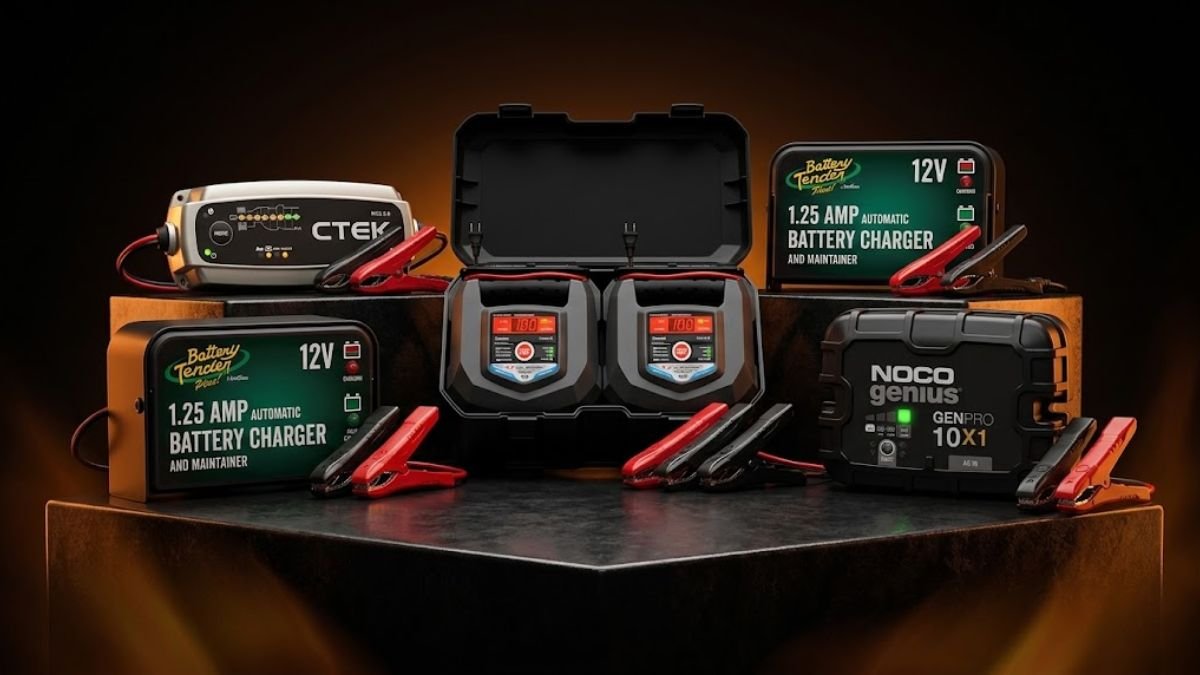
A vehicle that sits for a few weeks can lose more battery charge than most owners expect. Short trips, cold mornings, a weekend car that rarely leaves the garage, a boat or motorcycle parked for the season: all of these slowly drain a battery that was perfectly healthy last month. Car battery chargers exist for exactly this problem. A good one restores what the battery has lost and, depending on the model, keeps it topped up so you are not stuck with a dead car on the day you need it.
The tricky part is that chargers are not interchangeable. Some are small maintainers built to sit on a battery for months. Others push more current for faster recovery. A couple of the units below are designed to live permanently on a boat. Knowing which job you actually need done matters more than any number printed on the box.
Comparison Table
| Product | Voltage | Charging Output | Charging Setup | Main Purpose |
|---|---|---|---|---|
| Schumacher Electric SC1280 | 6V and 12V | 15A | Single charger, sold as a pack of 2 | Charging and maintaining compatible vehicle batteries |
| CTEK MXS 5.0 | 12V | 4.3A | Fully automatic | Battery charging and long term maintenance |
| Battery Tender Plus | 12V | 1.25A | Float charging | Maintaining batteries on cars, motorcycles, and ATVs |
| NOCO GEN5X2 | 12V | 10A | 2 bank onboard charger | Maintaining two batteries in a marine setup |
| NOCO GENPRO10X1 | 12V | 10A | 1 bank onboard charger | Maintaining one battery in a marine setup |
Our Take
The five chargers fall into three rough groups, and that is more useful than comparing them one by one.
The Battery Tender Plus and the CTEK MXS 5.0 are the classic garage companions. Both are built around gentle charging and long term upkeep rather than speed. The Battery Tender is the lighter touch of the two, with a lower current that suits smaller batteries and vehicles that mostly sit. The CTEK offers more current, which gives it a bit more reach if the battery is bigger or has run down further.
The Schumacher SC1280 sits in its own corner. It supports both 6 volt and 12 volt batteries and arrives as a pair, which changes the math for anyone juggling a daily driver, a spare vehicle and perhaps something older with a different battery system.
The two NOCO units are a different animal. They are onboard marine chargers, meant to be installed on a boat and left connected. They make sense for boat owners, and they are not a drop in replacement for a portable garage charger. The GEN5X2 handles two batteries, and the GENPRO10X1 handles one.
Pick by situation: how many batteries, what voltage, where the charger will live, and whether you want something to pull out occasionally or leave hooked up for months.
Schumacher Electric SC1280 Battery Charger and Maintainer, Pack of 2

- The information below is per-pack only
- PREVENT BATTERY FAILURE: Ensure reliable starts after storage with this 4-in-1 device that charges, maintains, tests, an…
- REVIVE DEAD BATTERIES: Delivers 15A rapid charging power to keep standard, AGM, gel, and deep-cycle batteries healthy, m…
The first thing worth noticing here is the quantity. You get two chargers in the box, which quietly solves a common household problem: one charger, three vehicles, and a rotation nobody remembers to follow. With a pair, you can leave one in the garage and keep another where a second vehicle or a family member’s car lives.
The SC1280 is listed with a 15A rating and support for both 6 volt and 12 volt batteries. That dual voltage support is the more interesting detail. Most modern cars run on 12 volt batteries, but older classics, some lawn equipment and certain vintage machines may use 6 volt. Having one charger that can handle both is handy if your driveway or shed holds a mixed bag.
As always, check your battery’s voltage and type before connecting anything. A charger that can do many things still has to be set up correctly for the battery in front of you. The product listing and the owner’s manual are the places to confirm which battery types and settings apply.
CTEK MXS 5.0 Fully Automatic Battery Charger and Maintainer

- Battery Charger: MXS 5.0 is a fully automatic 8-step battery maintainer that provides an outstanding charging experience…
- Improved Charging: MXS 5.0 is designed to optimally charge in all conditions. Whether it’s marine, car, bike, RV or trac…
- Maximize Lifetime and Capacity: The 4.3 amp battery charger’s reconditioning function can improve the lifespan of health…
CTEK has a following among people who care about battery health, and the MXS 5.0 shows why. It is a 12 volt charger rated at 4.3 amp, and it is described as fully automatic, meaning it manages the charging process on its own once connected.
That automatic behavior is the real selling point for a normal owner. You do not have to watch the clock or guess when to unplug. Connect it, let it work, and it moves from charging into maintaining the battery rather than just cooking it until you remember to come back.
The current sits in a comfortable middle ground. It is meaningfully stronger than a pure trickle style maintainer, yet still moderate enough to be a sensible choice for regular car battery charging at home. If you have a car that gets driven irregularly or a vehicle that spends the winter parked, this is the kind of charger that earns a permanent spot on the workshop shelf.
Check the product page for which battery types it supports before you buy, especially if your car uses an unusual battery technology.
Battery Tender Plus 12V Car and Motorcycle Battery Charger and Maintainer

- Adaptive Smart Charging: Our battery maintainer adapts to the needs of your 12V battery, ensuring optimal charging and e…
- 4-Step Charging Program: This 12V battery charger safely charges and maintains your battery utilizing a 4-Step program t…
- Includes: 12V, 1.25 AMP battery charger, fused ring terminal and alligator clip accessory cables, 10-year manufacturer’s…
This is the quiet one of the group. At 1.25 amp, it is not trying to revive a flat battery in an afternoon. Its job is closer to babysitting. It delivers a gentle float charge that tops up a battery and keeps it from sliding downhill while a vehicle sits.
The listing places it across cars, motorcycles and ATVs, which tells you where it fits best: smaller batteries and vehicles that are used in seasons. A motorcycle that hibernates all winter, a quad that only comes out on weekends, or a second car that rarely moves are all natural matches.
The trade off is speed. If a larger car battery is thoroughly drained, a low current unit will need a long time to make progress. Think of it as protection against the slow drain, not a quick rescue tool. For a lot of owners that is exactly the job they need done, and a simple, low current maintainer is easy to live with.
NOCO GEN5X2 12V 10A 2 Bank Onboard Marine Battery Charger and Maintainer

- MEET THE GEN5X2 — 37% smaller and 43% more powerful than the GENM2. It’s our most compact and advanced onboard charger y…
- MULTIPLE BANKS — A two-bank onboard battery charger rated at 10 amps total – 5 amps per bank. Independently charge 12V b…
- CHARGING MODES — Selectable modes for each bank: 12V, 12V AGM, 12V Lithium, and 12V Repair Mode. Independently charge an…
Start with the category, because it changes everything else. The GEN5X2 is an onboard marine charger. It is designed to be installed on a boat and wired in, so the batteries are charged without being disconnected and carried to a bench.
The two bank layout is the headline feature. Boats commonly carry more than one battery, often one for starting the engine and another to run electronics and accessories. Two banks mean each battery can be served from one charger unit. The listing gives a 10A rating for the unit, so look at the product details for how that output is shared between the banks.
Anyone considering this for a regular car should pause. It is not marketed as a plug it in and walk away garage charger, and I would not treat it as one. If you own a boat, particularly one with a dual battery setup, it deserves a look. If you own only a sedan, one of the portable options above will fit better.
NOCO GENPRO10X1 12V 10A 1 Bank Onboard Marine Battery Charger and Maintainer

- MEET THE GENPRO10X1 — 41% smaller and 33% more powerful than the GEN1. It’s our most compact and advanced onboard charge…
- SINGLE BANK — A one-bank onboard battery charger rated at 10 amps total – 10 amps per bank. Independently charge 12V bat…
- CHARGING MODES — Selectable modes for each bank: 12V, 12V AGM, 12V Lithium, and 12V Repair Mode. Independently charge an…
The GENPRO10X1 shares the same marine focus as its two bank sibling, but it is built for a simpler boat: one battery bank. With a 10A rating on a single bank, it puts the charger’s full output toward one battery rather than splitting attention.
That makes it a tidy match for smaller boats or setups with a single battery to maintain. Because it is an onboard marine unit, the idea is permanent installation, so the charger lives on the vessel and the battery stays topped up between trips.
Be honest about your use case. A boat sitting at a slip or in a storage yard benefits from this kind of fixed installation. A car in a driveway usually does not, since mounting and wiring a marine charger is more work than clipping on a portable unit. Confirm battery type and installation requirements in the product documentation before you commit.
What to Check Before Buying
Battery voltage. Most cars use a 12 volt battery, but some older or specialty equipment uses 6 volt. Match the charger to the battery, not the other way around. A 12 volt battery charger is the common starting point for modern vehicles.
Battery chemistry. Lead acid, AGM and lithium batteries do not all want the same charging profile. Look at what the manufacturer says the charger supports, and compare it with what your battery label says.
Charging current. Higher amperage charges faster but is not automatically better. A small maintainer is kind to a small battery and perfect for storage. A stronger charger recovers a larger battery sooner. Consider how quickly you actually need the result.
Automatic charging. Fully automatic models take much of the guesswork away. For ordinary owners who do not want to babysit a charger, this is a significant convenience and a safety plus.
Battery maintenance and storage. If a vehicle sits for weeks, a maintainer that holds the battery steady is worth more than a powerful unit used once a year. Regular battery maintenance extends the life of the battery you already own.
Safety protection. Look for protections such as reverse connection warnings and spark control, and always follow the instructions. Charge in a ventilated space and keep metal tools away from terminals.
Number of batteries. One vehicle and one battery is a simple case. Two or more calls for a pair of chargers or a charger with more than one bank.
Vehicle type. Cars, motorcycles, ATVs and boats have different batteries and different habits. Make sure the charger lists your type of vehicle.
Connection and installation. Clamp style chargers are easy to move around. Permanent onboard marine units need proper installation. Be realistic about how much work you are willing to do.
Know your battery first
A charger is only as useful as the battery it is treating. If your battery is old, swollen or no longer holds charge, a new charger will not fix it. Our guide to car and truck batteries for maximum starting power explains how to judge battery condition and when replacement makes more sense than another charge.
Charging is not the same as starting
It helps to separate two jobs that people often mix up. A charger slowly restores a battery’s stored energy over hours. A jump starter delivers a quick burst to get an engine running right now. If you are stranded in a parking lot, a charger is not the answer, and that is when portable jump starters for roadside emergencies are the better tool.
Think about the roadside too
Keeping batteries healthy lowers your odds of trouble, but it never removes them. Pairing good battery habits with a sensible trunk setup makes sense, and car emergency kits for real roadside situations cover the gear that helps when something goes wrong away from home.
Final Thoughts
These five chargers solve different problems, and that is the useful takeaway. The Battery Tender Plus is a low current maintainer for vehicles that sit. The CTEK MXS 5.0 offers fully automatic charging at a moderate current for everyday car use and storage. The Schumacher SC1280 brings 6 volt and 12 volt support in a two pack, which suits households with several batteries to look after. The two NOCO chargers belong on boats, with the GEN5X2 covering two battery banks and the GENPRO10X1 serving one.
Start with your battery voltage, your vehicle type and how you actually use it. The right charger is the one that fits that routine, and it will pay you back in fewer dead battery mornings.
FAQ
1. Can a battery charger replace a jump starter?
Not really. A charger restores energy slowly, while a jump starter gives a quick boost to start an engine. They solve different problems, and many owners keep both.
2. Is it safe to leave a maintainer connected for months?
Chargers described as maintainers or float chargers are designed for extended connection. Still, follow the manufacturer’s instructions and check the battery from time to time.
3. How do I know if my battery is 6 volt or 12 volt?
The label on the battery usually shows the voltage. If it is unclear, check the vehicle manual or ask a parts counter before connecting a charger.
4. Will a small charger work on a big car battery?
It can maintain one, but recovering a deeply drained battery will take a long time. For larger batteries, a charger with more current will save patience.
5. Can I use a marine charger on a car?
The NOCO units here are onboard marine chargers meant for installation on boats. For a car, a portable charger designed for automotive use is the simpler choice.