Picture yourself pulled off at a rest stop for the night, or parked in the driveway during a blackout, with a battery bank charged and ready but nothing running off it yet. A laptop charger will probably tolerate whatever comes out of a cheap inverter without complaint. A CPAP machine won’t be so forgiving, and neither will a refrigerator compressor that’s trying to restart itself for the third time in an hour. That gap between “it turned on” and “it actually runs the way it’s supposed to” is where the difference between a pure sine wave inverter and a cheaper modified wave unit stops being a spec sheet argument and starts being a real problem.
Pure sine wave output mimics the power coming out of a wall outlet at home. That matters a lot for anything with a motor, a compressor, or electronics sensitive enough to notice the difference. But picking the right inverter isn’t just a matter of finding the biggest wattage number on the box and calling it done. Continuous output, surge capability, how forgiving the input voltage range is, how efficient the unit runs, and what the installation actually demands all factor into whether an inverter meets a real need or just looks good in a listing.
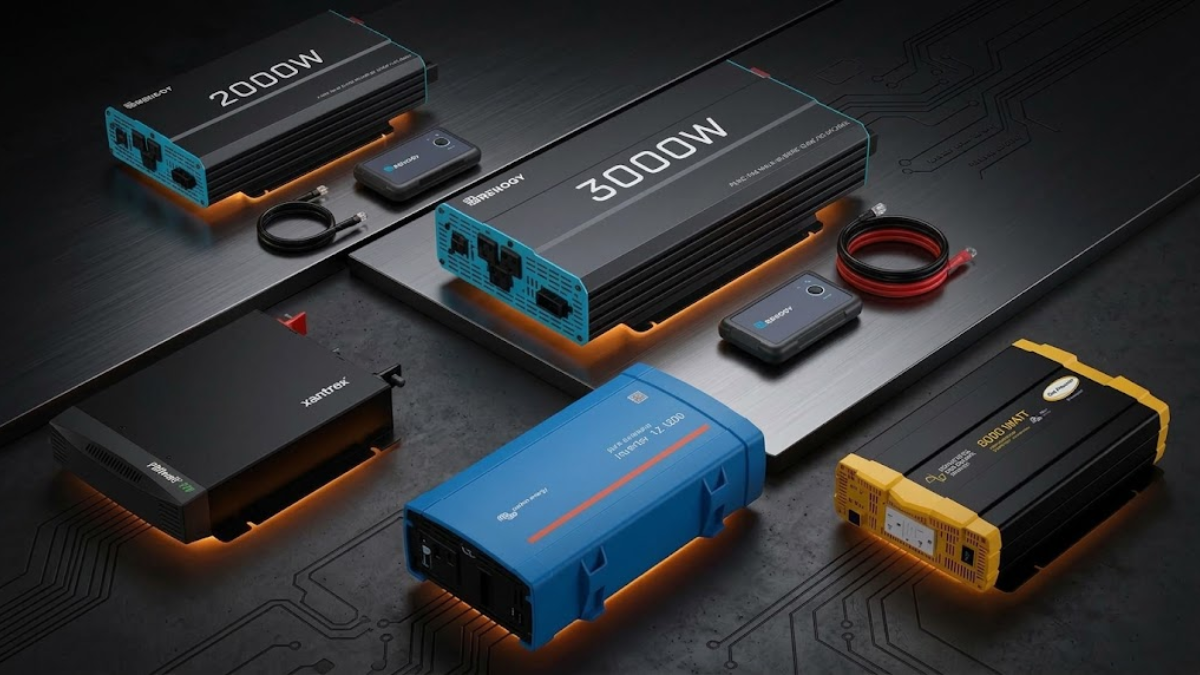
This guide walks through five pure sine wave inverters that show up often in RVs, trucks, and off grid battery setups: the Go Power GP ISW2000 12, the Victron Energy Phoenix 12/1200 VE Direct, the Xantrex PROwatt SW2000, the Renogy Inverter P2 3000W, and the Renogy Inverter P2 2000W. Each one is built around a different set of priorities, whether that’s raw output, monitoring, adaptability, or footprint, and knowing what separates them makes it a lot easier to match a product to an actual electrical load instead of guessing from marketing copy.
Quick Comparison
| Product | Continuous Output | Peak Output | Input | AC Outlets | Key Features |
|---|---|---|---|---|---|
| Go Power GP ISW2000 12 | 2000VA | Under 3500VA | 10.5 to 16.5V DC | 2 GFCI | Selectable voltage and frequency |
| Victron Phoenix 12/1200 VE Direct | 1200W | 1600W for up to 15 seconds | 12V | 1 | VE Direct, ECO mode |
| Xantrex PROwatt SW2000 | 1800W | 3000W | 10.5 to 15.5V DC | 2 GFCI | Digital display, USB |
| Renogy Inverter P2 3000W | 3000W | 6000W | 12V | 3 | Wired remote, low THD |
| Renogy Inverter P2 2000W | 2000W | 4000W | 12V | 3 | Wired remote, low THD |
None of these five is objectively better than the others. They’re built for different jobs, and the table above is meant to help you spot which specs line up with what you actually need rather than push you toward one option.
How to Choose a Pure Sine Wave Inverter
Continuous power versus surge power
Continuous power is what an inverter can put out all day without overheating or tripping a protection circuit. Surge power, often called peak power, is a short burst rating meant to absorb sudden spikes in demand, usually lasting anywhere from a fraction of a second to fifteen seconds or so depending on who makes the unit. Treating these two numbers as interchangeable is a mistake. A big surge rating paired with a modest continuous rating still leaves you stuck if you’re trying to run something for more than a few seconds beyond what the unit can sustain.
The inverter is only part of a complete roadside power setup. Your car and truck battery for maximum starting power, portable jump starter for roadside emergencies, and car emergency kit for real roadside situations can each serve a different purpose alongside it. Considering these needs together can help you choose equipment that fits your actual situation.
Startup loads
Refrigerators, AC compressors, water pumps, and anything with an electric motor pull far more current in the instant they kick on than they do once they’ve settled into a steady run. That inrush is exactly why surge ratings exist. An inverter that looks properly sized based on running wattage alone can still fail to start a compressor if its surge headroom isn’t there when it’s needed.
Battery voltage and current demand
Every inverter on this list pulls from a nominal 12 volt DC battery bank to produce 120 volt AC output. Because that input voltage sits so much lower than the output, higher AC wattage translates into a lot of DC current. A 3000W continuous load on a 12V system can pull well over 250 amps, though the exact number shifts depending on the battery’s actual voltage under load, the inverter’s efficiency, and what’s really being drawn at that moment. It’s not a fixed figure, but it explains why battery capacity and cable sizing become serious considerations once you move into higher wattage territory.
Efficiency and standby consumption
Efficiency is a measure of how much stored battery energy actually becomes usable AC power versus how much gets lost as heat along the way. No load or standby consumption is the current an inverter draws just by sitting there switched on, whether or not anything’s plugged in. If you’re the type to leave the inverter connected for long stretches, standby draw ends up mattering just as much as peak efficiency, since it quietly eats into the battery even with nothing running.
Pure sine wave output
A pure sine wave replicates the smooth, consistent waveform utility power delivers. That matters for sensitive electronics, variable speed motors, and certain power supply designs. Some equipment may misbehave, run less efficiently, or hum audibly on a rougher waveform, though how much that shows up varies by device and shouldn’t automatically be read as damage waiting to happen.
Protection and installation
GFCI protected outlets cut power fast when there’s a ground fault, which matters a great deal in RV, marine, or outdoor settings where moisture is a fact of life rather than a remote possibility. Higher wattage inverters tend to be built for hardwired installation instead of a simple plug in connection, which means proper cable sizing and fusing become part of setting the thing up, not optional extras. Ventilation and mounting space also need thought, since these units throw off heat during operation and depend on airflow to avoid a thermal shutdown. None of this requires an electrician’s license, but it does mean sticking to the manufacturer’s stated cable gauge and fuse recommendations instead of improvising something that seems close enough.
Go Power GP ISW2000 12

The GP ISW2000 12 puts out 2000VA of continuous pure sine wave power, and what sets it apart isn’t the number itself but the flexibility built around it. Instead of locking you into one regional standard, it lets you select AC output at 100V, 110V, 115V, or 120V, and choose between 50Hz and 60Hz. That kind of adjustability is genuinely uncommon at this price point, and it’s worth something to anyone running equipment built to a different voltage standard than what’s typical in North America.
Its DC input range runs from 10.5 to 16.5V, giving it reasonable tolerance for the swings a 12V battery bank naturally goes through as it charges and discharges. Per the manufacturer, surge stays under 3500VA for one second, and that figure should override any higher surge numbers you might spot in a retail listing, since the manufacturer’s own documentation is the more trustworthy source. Peak efficiency lands around 92 percent, and two GFCI protected outlets add a real margin of safety for anyone using it near moisture or sensitive equipment. It weighs roughly 11.55 pounds, measures about 17.45 by 9.76 by 3.27 inches, and carries a two year warranty.
Pros
- Selectable AC voltage and frequency, unusual flexibility for this class of inverter
- Efficiency near 92 percent, on the high side for this power range
- Dual GFCI outlets, a meaningful safety margin for RV or marine use
- Compact footprint relative to its 2000VA rating
Cons
- Surge capacity under 3500VA falls short of some higher figures advertised on other listings for similar units
- Not built for the heaviest startup loads that need a large surge cushion
- Still requires a battery bank able to sustain meaningful current under a full continuous load
Victron Energy Phoenix 12/1200 VE Direct

Where the other four inverters in this lineup lean toward output, the Phoenix 12/1200 leans toward visibility. It delivers 1200W continuous at 25 degrees Celsius, tapering to 1100W at 40 degrees Celsius as internal temperatures climb, with a 1600W peak available for up to fifteen seconds to cover brief startup spikes.
Output runs at 120V AC, 60Hz, through a single NEMA 5 15R outlet, and the pure sine wave waveform keeps it suitable for delicate electronics. What really separates it from everything else on this list is the VE Direct interface, which opens up monitoring and configuration through compatible Victron gear. Smartphone monitoring is possible too, though it typically needs a separate Bluetooth Smart dongle rather than coming with wireless built in from the start. An ECO mode drops the unit into a low power state once connected loads fall below a set threshold, which helps stretch battery life during quiet periods. Peak efficiency sits around 91 percent.
Pros
- VE Direct interface gives real visibility into battery voltage, load, and alarm status
- ECO mode conserves battery capacity automatically during light or no load periods
- Pure sine wave output at 91 percent efficiency, well matched to sensitive electronics
Cons
- 1200W continuous can’t touch the heavier loads the Renogy or Go Power units are built to handle
- Full smartphone monitoring requires buying a separate Bluetooth dongle
- Lower continuous and peak ratings rule it out for appliances with demanding startup current
Xantrex PROwatt SW2000

The name alone might suggest 2000 watts of continuous output, but the PROwatt SW2000 is actually rated for 1800W continuous, with 3000W of surge capacity. That’s worth flagging clearly, since anyone sizing their setup off the product name rather than the documented spec sheet could end up short.
It runs off a 12V nominal DC input, with an operating range of 10.5 to 15.5V, and produces true sine wave AC across a 104 to 127V window at 60Hz. Two GFCI protected outlets come standard, along with a USB port rated at 5V and 500mA, and a digital display that shows real time operating information without needing a separate app or accessory. Installation is hardwired rather than plug in, and the manufacturer specifies a 250A fuse for the job. Peak efficiency reaches about 90 percent, and no load consumption stays under 0.6A. It weighs roughly 10.7 pounds, measures about 3.9 by 11.8 by 13.7 inches, and comes with a two year warranty.
Pros
- Dual GFCI outlets plus a built in digital display for at a glance monitoring
- 90 percent efficiency with low no load draw, reasonably economical to leave connected
- Hardwired design tends to hold up better against vibration in a moving vehicle
Cons
- Actual continuous output of 1800W falls short of what the SW2000 name implies
- Hardwired installation demands more planning and correct fusing than a plug in unit
- 3000W surge capacity trails the Renogy units for larger startup loads
Renogy Inverter P2 3000W

The Renogy P2 3000W is built around sustained high output, running 3000W continuously with a 6000W peak for handling demanding startup loads. It’s the biggest capacity unit in this comparison, and that comes with real requirements on the battery and wiring side to match. A genuine 3000W continuous load on a 12V system can pull well over 250 amps, with the exact figure depending on actual battery voltage under load, inverter efficiency, and the specific draw at any given moment, which is exactly why battery capacity, cable gauge, and fusing stop being optional once output climbs this high.
Three AC outlets come standard, along with a USB port rated at 5V and 2.1A, and a wired remote controller that lets you operate the unit from somewhere other than its mounting spot. Nominal efficiency clears 90 percent, and total harmonic distortion stays under 3 percent for linear loads and under 5 percent for nonlinear loads, both signs of a clean output waveform. A thermally controlled fan handles cooling, and the unit carries ETL listing. It measures about 18.9 by 9 by 4 inches and weighs roughly 12.5 pounds.
Pros
- 3000W continuous with 6000W peak, capable of running loads smaller units simply can’t
- Three AC outlets, more simultaneous connections than most competitors here
- ETL listing and documented THD figures offer real assurance on output quality
Cons
- Supporting genuine 3000W continuous demands a battery bank and wiring built for that load, a serious investment beyond the inverter itself
- Largest physical footprint in this comparison, needing more mounting space
- Running it well under capacity gives little advantage over the smaller Renogy while adding unnecessary bulk
Renogy Inverter P2 2000W

The P2 2000W shares its design language with its bigger sibling but scales output down to 2000W continuous with a 4000W peak. The same three AC outlets, the same USB port rated at 5V and 2.1A, and the same wired remote controller all carry over, just packaged into a smaller unit.
Nominal efficiency clears 90 percent, matching the 3000W model, and the THD numbers are identical too: under 3 percent for linear loads, under 5 percent for nonlinear ones. A thermally controlled fan manages heat, and it carries the same ETL listing. It measures about 17.8 by 8.6 by 4 inches and weighs roughly 11.7 pounds, a bit lighter and more compact than the 3000W version.
Pros
- Same outlet setup, efficiency, and THD performance as the 3000W model, in a lighter package
- 4000W peak still gives meaningful headroom for startup loads without extreme current demands
- Needs a less extensive battery and wiring setup than the larger model while covering most moderate to demanding loads
Cons
- 2000W continuous ceiling isn’t enough for the heaviest simultaneous loads the 3000W version handles
- Still requires attention to battery capacity and cable sizing, just at a somewhat reduced scale
- Anyone running several high draw appliances at once may find the capacity limiting
Common Mistakes When Buying a Pure Sine Wave Inverter
Buying the wrong inverter, or the right one without the infrastructure to back it up, happens more often than it should. A few things worth watching for:
- Choosing an inverter based on advertised peak or surge wattage without checking the continuous rating.
- Ignoring startup loads from compressors, pumps, or motors, then being caught off guard when the unit shuts down under demand.
- Undersizing the battery bank relative to what the inverter actually draws at full continuous load.
- Using cables too thin for the current involved, which drives up voltage drop and heat.
- Skipping proper fusing, or using a fuse rating that doesn’t match the manufacturer’s spec.
- Forgetting that inverters generate heat and need real ventilation to avoid a thermal shutdown.
- Assuming any 12V inverter can safely run a 3000W load continuously without upgrading the battery and wiring to match.
- Overlooking standby or no load consumption, which quietly drains a battery even with nothing running.
- Confusing VA ratings with actual watts, since the two aren’t always identical depending on power factor.
- Choosing an inverter based on the number in its product name rather than its documented continuous output.
- Underestimating how much pure sine wave output matters for sensitive electronics that may behave unpredictably on a lower quality waveform.
- Failing to plan installation ahead of time, especially for hardwired units that need proper cable routing and fusing before they’re ever switched on.
Final Thoughts
These five inverters cover a meaningful spread of continuous output, surge capability, and feature sets, and nothing here is universally correct. The Victron Phoenix 12/1200 VE Direct fits someone whose loads are modest but who genuinely values system monitoring and integration. The Go Power GP ISW2000 12 and Xantrex PROwatt SW2000 sit in a middle tier, with continuous output between 1800W and 2000VA that covers a wide range of RV, truck, and marine uses without demanding the most extensive battery infrastructure. The Renogy P2 2000W occupies similar territory with a different outlet configuration and feature set, while the Renogy P2 3000W is built for anyone who needs genuinely high continuous output and is prepared to invest in the battery capacity and wiring that level of power actually requires.
Matching an inverter to what you actually need, rather than chasing the biggest number on the shelf, remains the surest way to end up with a setup that holds up over time.
FAQ
Is a pure sine wave inverter worth choosing for sensitive electronics?
Yes, especially when you plan to run equipment that contains electronic controls, motors, compressors, or switching power supplies. A pure sine wave inverter produces AC power that more closely matches the electricity supplied by the grid. That can help equipment such as laptops, medical devices, refrigerators, televisions, and other sensitive electronics operate more normally than they might with a modified sine wave inverter. It does not automatically make every device compatible, however. You still need to check the equipment’s power requirements and make sure the inverter can handle both its continuous load and any startup demand.
How much inverter capacity do I actually need for an off grid setup?
Start with the equipment you expect to run at the same time rather than choosing an inverter based only on the largest appliance you own. Add the continuous wattage of those loads, then leave enough additional capacity for startup surges and normal fluctuations. For example, an inverter rated at 2000W continuous is not automatically suitable for a group of devices that happens to total 1900W if one of them has a large startup surge. The battery bank, cables, fuses, and connections also need to support the current required by the inverter.
Why can a 3000W inverter draw more than 250 amps from a 12V battery?
Because the inverter has to convert relatively low battery voltage into usable AC power. At a theoretical 3000W load, a 12V system would require about 250 amps before accounting for conversion losses. In real use, the battery voltage changes under load and the inverter is not 100 percent efficient, so the actual current can be higher. This is why a high power 12V inverter requires properly sized cables, suitable overcurrent protection, and a battery system capable of delivering the required current without excessive voltage drop.
Is a 2000W pure sine wave inverter enough for an RV, truck, or backup power system?
It can be, but the answer depends on what you intend to run at the same time. A 2000W inverter can handle many common loads such as laptops, televisions, chargers, small appliances, and selected power tools, provided their combined demand stays within the inverter’s continuous rating. Appliances with motors and compressors can require substantially more power when starting. If those loads are part of your setup, check both their running wattage and startup requirements instead of assuming that a 2000W label is sufficient.
What should I check before connecting a pure sine wave inverter to a 12V battery?
Check the inverter’s continuous and surge ratings, the battery voltage range, the expected current draw, and the cable and fuse requirements before making the connection. A high power inverter can draw hundreds of amps from a 12V battery system, so undersized cables or inadequate connections can create excessive voltage drop and unwanted heat. It is also important to install the inverter in a location with adequate ventilation and to follow the manufacturer’s wiring and protection requirements. The inverter is only one part of the system, and the battery, wiring, protection devices, and loads all need to be suitable for the power you intend to use.